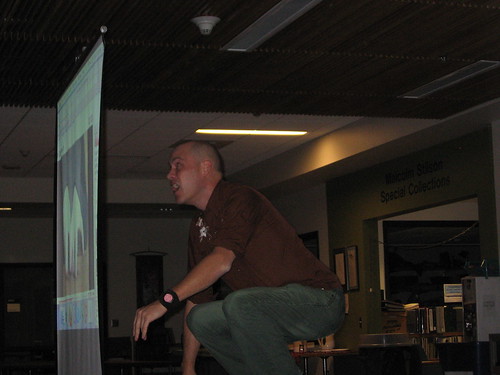
David Buuck performs at Evergreen for PRESS Series, 2009
This is a question that I put to David Buuck last October. David, of course, is one of the few poets who actually does "cover" work by other poets. Immediately we hit on the promise of money and fame as the answer to my question, and then began to seriously think about who covers and who is most often covered. Clark Coolidge was one name we came up with who does both, and in fact his The Crystal Text
was just covered by a bunch of poets in Portland. "Language Poetry" and poets working in and around both coasts in the 70s' and 80s' seemed, and still seem, more nimble in this regard, with poets like Joan Retallack not only covering work ranging from John Cage's to Eipcurus, but encouraging this as a poethical pedagogy at Bard College and elsewhere. The spirit of improvisation, the riff, the collaborative language play of Language Poetry is one of the engines here--thinking just off the top of my head of Ron Silliman's impovs, Hank Lazer stopping to cover work throughout his readings, Charles Bernstein constantly seeking collaborators for his work, more recently, opera. So too, one could call a lot of what goes on in poets theater (cf post below) cover work, and a lot of "conceptual poetry" might be definable, at least among a few poets, most notably Kenneth Goldsmith, as all cover all the time (though not taken by Kenny G.'s work a lot of the time, I must say his songs, though not covers in the semse I'm talking about--
especially the Wittgenstein and the Barthes--are nonetheless especially awesome). And there are others out there doing what might be thought of as cover work, but this is really a small group amidst an already small constellation of people.
What is a poetry "cover" exactly? Perhaps because the mind often immediately shifts to music and bands, especially jazz and its history of refashioning works "invented" by other artists, the "cover" often seems straightforward. One could say: why don't more poets read other poets' poems during readings? And yet, in text arts, we've been (rightly and interestingly) wrangling over questions of agency, authorship, and identity for longer and in deeper ways than have, say, art rockers who turn tunes, say, from Destroy All Monsters into nearly unrecognizable "other" pieces (cf. Sonic Youth). "We're always doing a cover," one might say, pulling out their Barthes and blowing the dust off it. Maybe get a little political about it too, search around for a wiki quote from Adorno and refashion that: "The cover is impossible, your understanding of authorship is a construct of the culture industry." We're more deeply entrenched in the nuances of these questions than either extreme--the straightforward notion of the cover and the (now) flippant "it's all rehashed language anyway" notion, one that would encourage me (perhaps rightly, but also incredibly uninterestingly in the 80s conceptual art sort of way) to write a cycle of poems using all advert language from the New York Times and then title it "Of Being Numerous."
Note that this caricature of poetry's conversations re art and agency, language and identity, comes from my situation as a person whose output is born of a process very much entangled in these questions for both aesthetic and (or as) political reasons, my work always not "mine" in a very real sense. I take poetry to be conversation, and as such, I am keen to point out to myself if not others that what I am doing is making legible these conversations via collage, appropriation, citation, mimicry, and other "appropriative" procedures. The found and rescued and the lyric are not mutually exclusive, not in a time when the picnoleptic is in each of us as catastrophic self. Occultations is trying and necessarily failing to make this argument in and thru mapping the body as site of resistance and thus shorn, muted, wrecked predicament. And so, sure, in a sense I am, as are many if not most others, making collage, and so doing covers.
So the difference is in degree. Otherwise all of us do covers at readings, therefore none of us do. Otherwise Buuck, or Kaia Sand and Jules Boykoff last night (the latter reading from Howard Zinn) aren't doing covers. So the degree of difference allows me to ask without logical ineptitude why it is that when I go to a reading, nearly without exception, poets do not read work by other poets--known work, public work. And I'm excluding from "covering" reading aloud the lone poem or poem-fragment of another, then moving on to reading, for the rest of the time, one's "own" work. This latter gesture is often gorgeous and inviting, but is more a nod to a particular work or worker, one that allows us to situate what we are doing within a particular context, and this is a kind of epigraphy. Nothing against epigraphy, nothing at all: Thom Donovan recently wrote a piece that asked whether he, and if not, who, is afraid that there's too much epigraphy out there, and my answer is that there can't be, that the epigraph serves myriad functions, but most often one that is a gesture of good faith and love to that person or work which one loves.
And it's the epigraph, this gesture of love (or this public declaration of love for another), that can be, just like our immersing ourselves in critical-creative conversation on the page, the seedling for a good live cover. The move from turning what we are doing on the page outward and making overt what and who we are covering has somehow become a chasmic leap for us. An unnatural act. Most of the work in aesthetic practice that I've done is "live" work, and I, too, have done very little to refashion another's work in a sustained way, in a way that makes this work central to the live event as opposed to some smaller part of it. And this is strange, because much of theater is about covering overtly, as is not just jazz, but the whole history of western music.
Occultations, for me, is a start--a long book that the writing of which is covering in the sense that most of its pages are "results" of a "feedback loop": rituals and procedures responding to concurrent (occulted) events that imprint themselves on the body and thus manifest publicly as body maps and spatial signs, looped back onto the page once more. This is nothing more than making overt what writing (and many other signing conventions) often does, what its motors, gears, guts look like. So, the leap into covering that which imprints itself ("a body without organs yet to be formed," as Deleuze puts it) should not be difficult. And yet it is.
Composer Arun Chandra and I have committed ourselves to constructing a series of covers to be performed, well, when we're done with the thing--spring? I'm starting to roll out a few covers here and there and it's not just incredibly fun/generative, but it's intimate. In direct opposition to the ironic reenactment, the questions are still similar: how can I (we) refashion, torque, etc., the existing structure such that the structure is recognizably what it is, yet riff on the work on what I (we) perceive to be its own terms? What's the harmonic spectrum the work affords? Where are its joints and why are they there? This is a close reading turned outward, and it's also a recovery project of sorts. I say "of sorts" because many times the work needs not be recovered--it's alive and well in the consciousness of those phantom collaborators I (we) project to be involved in making the piece legible during an evening.
At moment we're at work on a piece by Buuck, a piece which has already been covered elsewhere, "Side Effect." Along with it, so far we're working on a new Tina Darragh's agit-prop, Weiss's Vietnam play for 15 voices, and the third book of Williams' Paterson (this one not my choice, but what the hell). What we end up with in terms of an hour piece of staged covers, each maybe 10-20 minutes long, I don't know. Still in the process of trying things out, with me at poetry readings the guinea pig, covering various short poems. Admittedly, I did do an ironic reenactment of a Gerald Stern poem at a reading a month ago, using four music boxes as sound track. Buuck's is so far the most challenging insofar as it is a darkly difficult play on "autobiography." So, we'll see how it goes, but the hope is that we can perform work that we love in ways that interest those beyond ourselves. Speaking of side effects, one such is that you don't have to hear "my" poems, which really is a plus for many, not just me.
The "why" here I think has a lot to do with the economics of poetry-text arts. Note there is one, and note too that the line "poetry doesn't sell, ergo there is no economy" should ring hollow. The reader is invited to read their work, not somebody else's. Audience expectation, even if the audience is all of 20 people, reinforces this. Audience expectation then understandably becomes curator expectation. So, that I'm working on a cover show doesn't really get at the problem, as expectations shift when the thing is billed as a cover show. Moreover, all these expectations feed into the "author's" expectations, and expectation becomes burden. I only have 20 minutes to get an audience to learn who I am, and so there is no room for me to perform others' work. The sheer number of working poets out there giving readings, poets who have books to peddle, who justifiably want people to know and enjoy their work, dictates that the cover will always be backgrounded.
This is too bad, in my estimation, as there's a lot we can do with and for each other if we dig more deeply into each other's passions while suspending--for just a minute--the discourse of critique, the ego of ownership. From Buuck experiencing a "cover" of Side Effect:
It was very hard to stand in back and watch/listen to someone else read that piece. To some degree because of content – it’s about my personal life, with some ‘embarrassing’ bits that I think I would not be as aware of as being publicly shared if I was reading it myself (ie experiencing it as the performing of language). But also I’m apparently even more of a control queen that I previously imagined. And my sense of duration changed – I mean, when you read at a poetry reading, often you can totally lose any sense of ‘regular’ time, but listening to my work being read (esp. work I’d only typed up two nights before) while I stood ‘helpless’ seemed to take forever. But all that was kind of the point – to see what would happen, how I would feel, to be ‘exposed’ to an audience in a different way, to give up the control of holding the text in my hands, at the front of the room, in charge of its dissemination, etc.
And the commodity discourse in poetry outlined need not be the case necessarily. In the hottest commodity sphere, the most pressurized aesthetic "market" of hip-hop, the cover is standard operating procedure. So, why not in poetry? Instead of reviews, why not more covers?